
Last Updated: 14th August 2026
Safeguarding Partnership Roundtable August 2026
Virtual College’s August 2026 Safeguarding Partnership Roundtable brought UK safeguarding leaders together to discuss training, emerging risks, partnership working and impact.
Safeguarding
Article
)
Safeguarding leaders come together at Virtual College’s Partnership Roundtable
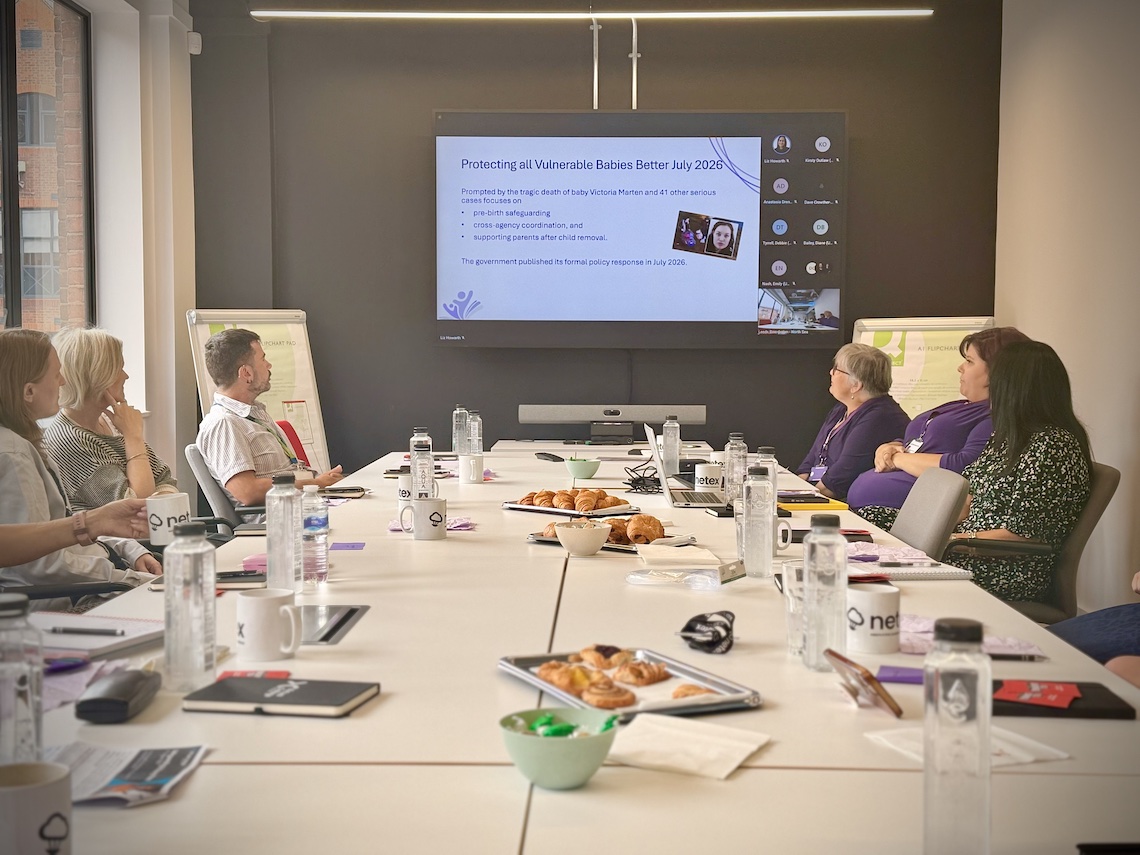
On 6 August 2026, Virtual College brought together safeguarding and workforce development leaders from across the UK for its Summer Safeguarding Partnership Roundtable.
Hosted in Leeds, the day brought together representatives from safeguarding partnerships across Lincolnshire, Bedfordshire, East Riding, Wiltshire, Hounslow and other areas, alongside colleagues from Virtual College and specialist guest organisations. The event provided an opportunity for safeguarding professionals to share experiences, explore emerging challenges and discuss how training and development can better support practitioners in practice.
The roundtable was deliberately structured around discussion and collaboration, with sessions covering the impact of domestic abuse on children, emerging safeguarding risks, multi-agency working, the future of safeguarding training and the challenge of measuring whether learning translates into improved practice.
Putting children’s experiences at the centre
The day began with a workshop from KADA Training Academy, exploring the impact of domestic abuse on children, from babies and unborn children through to adolescence.
The session encouraged participants to consider safeguarding situations from a child’s perspective and examine the practical and emotional challenges faced by children and families experiencing domestic abuse.
This included discussion around the many considerations involved when leaving an unsafe home, as well as the anxiety, uncertainty and disruption that children can experience.
The workshop reinforced an important principle for safeguarding professionals: children’s experiences cannot always be understood through case records or individual disclosures alone. Practitioners need the knowledge and professional curiosity to consider the wider circumstances surrounding a child.
This is reflected in Virtual College’s wider safeguarding training courses, which include learning designed to help professionals recognise concerns, understand their responsibilities and respond appropriately.
Making safeguarding training more relevant to different sectors
A major focus of the roundtable was Virtual College’s approach to developing its safeguarding learning offer.
Virtual College currently has more than 50 courses within its safeguarding library, supporting learners across education, healthcare and social care. The team explained how partnering with experts is vital to ensure Virtual College’s training reflects the responsibilities, legislation and working environments relevant to learners.
This builds on Virtual College’s existing Safeguarding Essentials collection, which includes core safeguarding courses alongside specialist subjects such as online safety, FGM and child criminal exploitation.
Keeping pace with emerging safeguarding risks
The roundtable also explored how quickly the safeguarding landscape is changing.
Online Safety was a particular area of discussion, with participants considering the impact of artificial intelligence, changes to mobile phone use in schools and the need for organisations to respond rapidly to emerging digital risks.
The discussion highlighted the importance of learning that can be updated and adapted as expectations and risks evolve.
There was also recognition that safeguarding responsibility extends well beyond frontline practitioners. School leaders, governance teams and multi-academy trusts increasingly need a clear understanding of their safeguarding responsibilities and how these fit within organisational governance.
From training completion to meaningful impact
One of the most valuable discussions centred on evaluation.
For safeguarding organisations, measuring whether someone has completed training is relatively straightforward. The harder question is what happens afterwards.
Has the learner remembered what they were taught? Have they used that knowledge in their work? Has their confidence changed? Most importantly, has the training changed practice?
Participants discussed the potential value of simple follow-up questions three or six months after training, particularly questions focused on whether knowledge has actually been applied in practice.
The conversation also recognised that individual learning does not automatically lead to organisational change. Practitioners need appropriate supervision, systems, leadership support and organisational cultures that allow them to apply what they have learned.
This means safeguarding leaders need to move beyond measuring attendance and completion towards understanding application and impact.
As the discussion highlighted, there remains a significant gap between knowing that someone has completed training and being able to demonstrate that the training has influenced their day-to-day practice or outcomes for children and families.
This will remain an important area for Virtual College as it continues to develop its learning and evaluation approach.
Exploring hidden forms of exploitation
The afternoon session featured guest speaker Laura Bainbridge, who explored hidden forms of safeguarding risk, including cuckooing victimisation and county lines-related exploitation.
The session considered risk factors, pathways into victimisation, relationships between victims and perpetrators, warning signs and how professionals can respond.
The discussion complemented Virtual College’s existing learning around child criminal exploitation. Its free Child Criminal Exploitation and County Lines course helps parents, carers and professionals recognise signs of exploitation and understand what to do when they are concerned about a child or young person.
Virtual College also offers dedicated Child Criminal Exploitation, Gangs and County Lines Training, covering subjects including grooming, vulnerability, county lines, exploitation indicators and appropriate action.
The roundtable discussion reinforced the importance of helping practitioners recognise safeguarding concerns that may not initially be obvious and understand the wider context surrounding children, young people and adults at risk.
Strengthening multi-agency safeguarding
Multi-agency working was another recurring theme throughout the day.
Participants discussed the importance of maintaining a shared understanding of safeguarding responsibilities while recognising that different professionals bring different perspectives, legislation and responsibilities to the same case.
This principle is also reflected in Virtual College’s Level 2 Safeguarding Children Training, which includes multi-agency working and helps learners understand how to recognise and respond to safeguarding concerns.
Accessibility and learner experience
The roundtable also provided an opportunity to discuss how safeguarding learning itself is evolving.
Virtual College has been modernising its learning content to make courses more accessible on mobile and tablet devices, moving away from traditional click-heavy formats towards more interactive, scrolling-based learning. The work also incorporates accessibility considerations, including alternative ways of accessing course content and transcripts.
This focus on accessibility is particularly important for safeguarding training, where organisations need to ensure that essential learning is accessible to diverse workforces.
Virtual College’s current Level 3 Safeguarding Children training, for example, incorporates WCAG 2.2 accessibility alongside scenarios, contextualised activities, reflective activities and knowledge checks.
Building safeguarding learning through partnership
The strongest message from the day was the importance of collaboration.
Bringing safeguarding leaders together gives Virtual College an opportunity to hear directly from the people responsible for developing workforces, commissioning training and supporting practitioners across the country.
It also creates space for safeguarding professionals to share local experiences, challenge ideas and identify common issues that may benefit from a collective response.
The roundtable forms part of an ongoing commitment to working alongside safeguarding partnerships to develop learning that is relevant, accessible and practical.
The conversations from 6 August will continue to inform the development of Virtual College’s safeguarding pathways, including sector-specific compliance training, specialist safeguarding topics and approaches to evaluating the impact of learning.
Ultimately, effective safeguarding training should be about more than completing a course. It should give professionals the knowledge, confidence and practical understanding to recognise concerns, respond appropriately and make a difference in their everyday work.
And that is why partnership matters: better safeguarding learning starts with listening to the people who use it.
Explore Virtual College’s safeguarding training
Discover the full range of Virtual College safeguarding courses, including Level 1, Level 2 and Level 3 learning, specialist safeguarding topics and training for different sectors and responsibilities.