
Last Updated: 20th November 2026
Emergency response in the workplace: 2026 research
New Virtual College research of 2,000 UK workers finds 54% don't know where their first aider or first aid kit is, and 79% wouldn't feel confident if a colleague collapsed.
Health & Safety
Article

More than half of UK workers (54%) don't know where to find their workplace first aider or first aid kit, and 11% say their workplace has neither. That is the headline finding from new Virtual College research into how prepared Britain's workplaces really are for an emergency.
We surveyed 2,000 employed UK adults about the training they've had, how confident they feel, and what gets in the way when something goes wrong at work. The results show a clear gap between the emergencies that happen every day and the skills people have to respond to them.
The headline findings
- 54% don't know where their workplace first aider or first aid kit is
- 79% wouldn't feel confident if a colleague collapsed at work
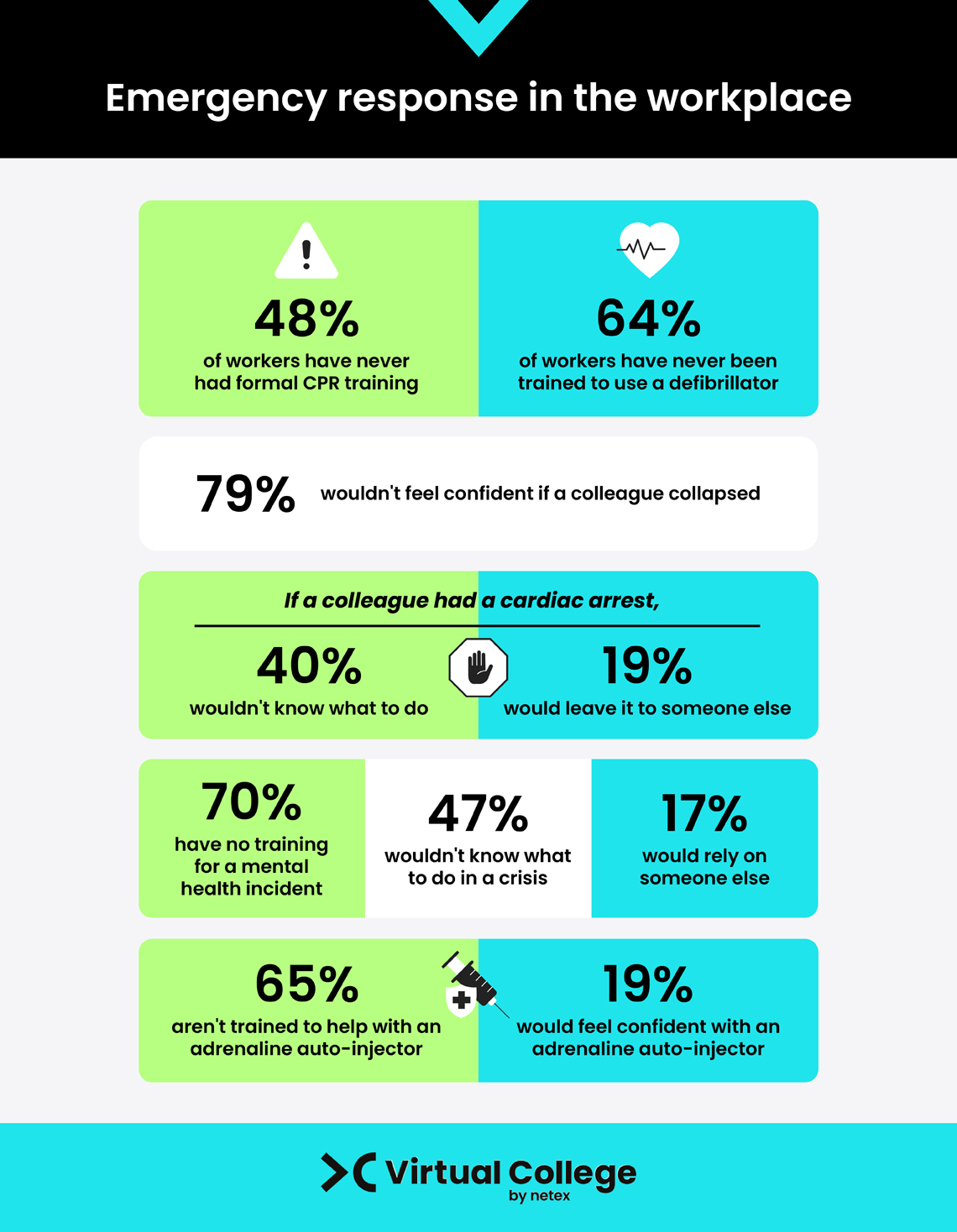
- 48% have never had formal CPR training
- 64% have never been trained to use a defibrillator
- 70% have no training for a mental health incident
- 43% have no fire safety training, even though it applies to every workplace
"With 69,219 workplace injuries recorded across all incident categories in the year 2024-2025, it's clear that accidents and injuries do happen in every working environment. An emergency can happen without warning, and those first few moments can make a critical difference. Whether someone has suffered a fall, been injured in an accident or suddenly collapsed, knowing who to turn to, where to find help and having the confidence to act is vital. First aid shouldn't be something we only think about when an emergency happens, it should be something every employee feels prepared for."
Jamie Ashforth, Business and Strategy Director, Virtual College
Findings by emergency type
| Emergency | What workers told us |
|---|---|
| Cardiac arrest | 40% wouldn't know what to do; 19% would leave it to someone else |
| CPR | 48% have never had formal CPR training |
| Defibrillators | 64% have never been trained to use one |
| Mental health crisis | 70% have no training; 47% wouldn't know what to do; 17% would rely on someone else |
| Severe allergic reaction | 65% aren't trained to use an adrenaline auto-injector; only 19% would feel confident using one |
| Fire | Only 57% are trained in fire safety |
| Finding help | 54% don't know where their first aider or first aid kit is; 11% say their workplace has neither |
The pattern is the same across every type of emergency. Most workers haven’t been trained, and many say they would wait for someone else to step in. In a cardiac arrest or a severe allergic reaction, that wait can cost a life.
Which groups are most left behind?
Some workers are less prepared than others, and the reasons go beyond training alone.
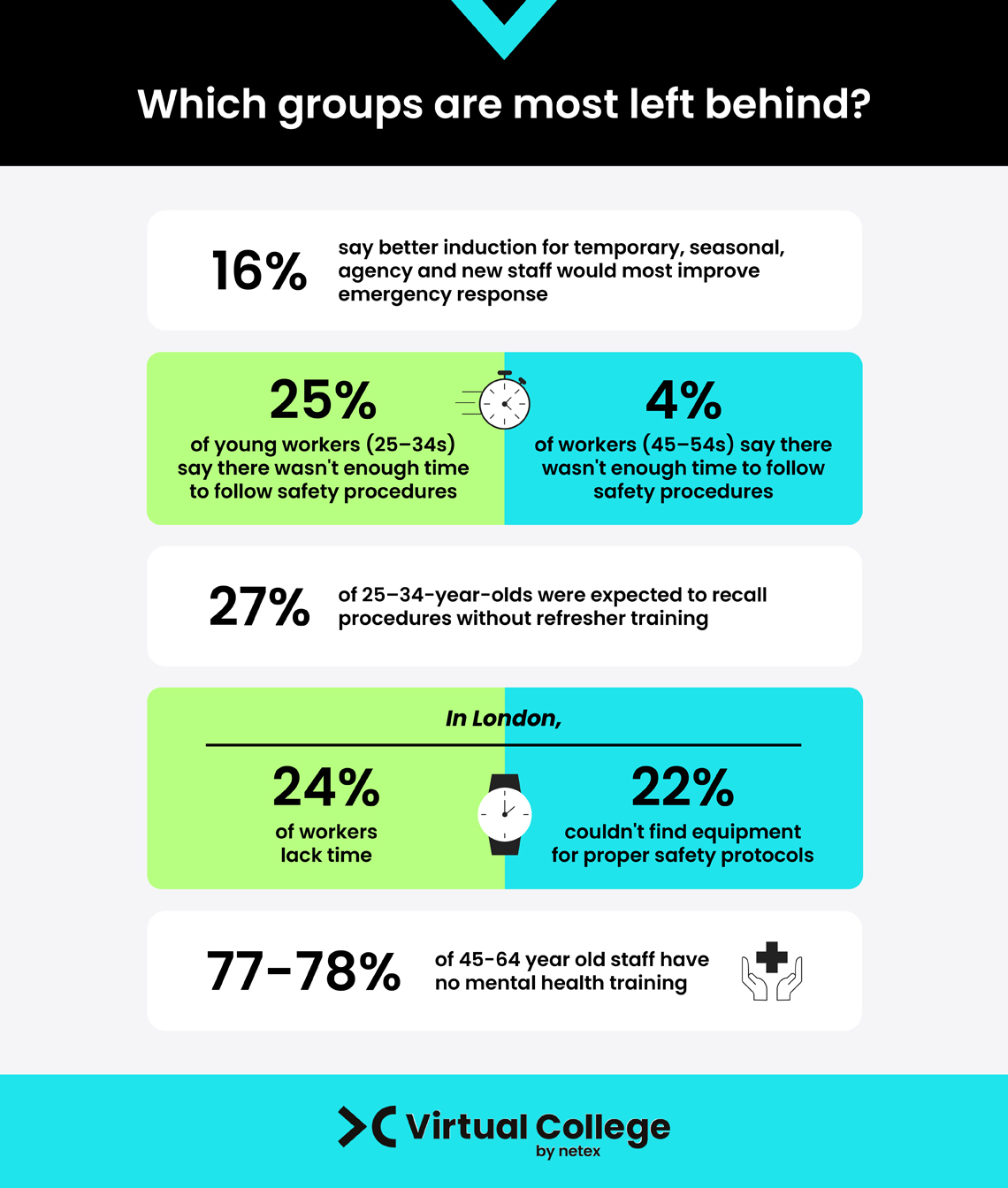
- Younger workers. A quarter (25%) of 25 to 34-year-olds say there wasn’t enough time to follow safety procedures, compared with just 4% of 45 to 54-year-olds. And 27% of 25 to 34-year-olds were expected to recall procedures without any refresher training.
- Older workers and mental health. 77 to 78% of staff aged 45 to 64 have no mental health training, the highest of any age group.
- New, temporary and agency staff. 16% of workers say better induction for temporary, seasonal, agency and new staff would do most to improve emergency response.
- Workers in London. 24% of London workers say they lack the time to follow safety procedures, and 22% couldn’t find the equipment they needed.
What employers can do now
- Make help easy to find. Tell every employee who your first aiders are and where the first aid kit, defibrillator and fire equipment are kept, and repeat it regularly.
- Train beyond the minimum. Give more people basic CPR, defibrillator, fire safety and mental health awareness training, not just your appointed first aiders.
- Include everyone at induction. Cover emergency arrangements on day one for new, temporary, seasonal and agency staff.
- Refresh regularly. Skills fade. Short, regular refresher training keeps people confident.
- Build in time. Make sure staff have time to follow safety procedures, especially in busy or fast-paced roles.
Our employer checklist turns these steps into a quick audit you can run this week.
Explore the research
- You know where the kettle is, but do you know where the first aid kit is? What employers must provide, and how to make sure everyone knows.
- What to do if a colleague collapses at work: simple steps anyone can follow.
- CPR and defibrillators at work: how to close the confidence gap: why the first few minutes count, and four common myths.
- Mental health emergencies at work: what to do in a crisis: how to spot a crisis and support a colleague.
- Anaphylaxis at work: how to help with an adrenaline auto-injector: the signs to look for and what to do.
- Fire safety training: why 43% of workers are missing out: what the law says and the common gaps.
- Are new and temporary staff being left behind in emergencies? Why induction and refresher training matter.
- Workplace emergency readiness in London: time and equipment fall short in the capital.
- Is your workplace emergency-ready? An employer checklist: a quick audit you can run this week.
Get your team emergency-ready
Virtual College offers CPD-certified and RoSPA-assured online training in first aid, fire safety, mental health and more, so your whole team can learn at their own pace.
Methodology
Data was collected through a survey of 2,000 employed UK adults, grouped by sector and region. Health and Safety Executive (HSE) data was collected and analysed to find fatal and non-fatal injuries across each sector.